Reviewing Hobby. Embroidery Collection. SVG for Business
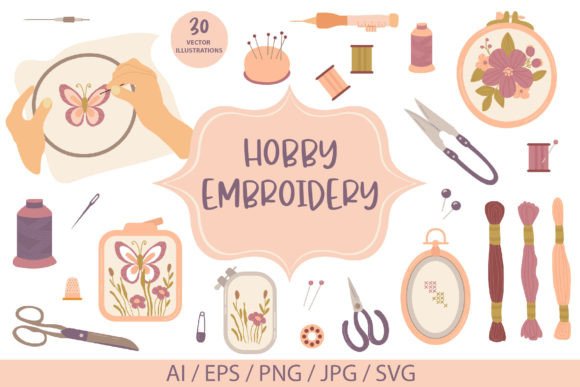
As an embroidery designer who has spent years digitizing files and consulting with small business owners, I approach every new asset with a critical eye. We are not just looking for pretty pictures; we are looking for functional design assets that translate well from screen to thread. Today, I am reviewing the Hobby. Embroidery Collection. SVG, a set of vector objects marketed under the Illustrations category. While the product description highlights its utility for postcards, invitations, and flyers, my focus is strictly on its viability for commercial embroidery and branded merchandise.
First Impressions: Visual Personality and Versatility
The title itself, Hobby. Embroidery Collection. SVG, suggests a playful, approachable aesthetic. In the world of small business merch, this is often exactly what brands need to soften their image. Unlike rigid corporate logos, hobby-themed graphics tend to feel friendly, rustic, or handmade. This collection appears to lean into that organic vibe. For boutique owners, bakeries, florists, or creative studios, this visual language builds immediate rapport with customers. It signals that the brand values craftsmanship and personal touch.
However, because these are vector objects intended for print media like posters and flyers, we must assess how they hold up when converted into a machine embroidery design. Vectors are infinitely scalable, which is excellent for resizing, but they do not automatically account for stitch limitations. The clean lines seen in digital Graphics can become muddy if the stitch density is too high or if the details are too fine for the needle to penetrate cleanly.
Real-World Application for Small Business Merch
Let us imagine a local café or a handmade pet brand wanting to elevate their small business merch. How does this collection perform? Here is where I see the most potential:
- Embroidered Patches: This is arguably the best use case. A patch allows you to isolate the design from the garment’s texture. You can create a high-quality embroidered patch using these vector shapes as a base, adding a merrowed edge for durability. This works perfectly for tote bags or denim jackets where direct embroidery might pucker the fabric.
- Apron Embroidery: For bakeries and craft workshops, staff aprons are walking billboards. The hobby-themed motifs in this collection can serve as charming chest accents. They add personality without overwhelming the uniform.
- Tote Bag Design: Canvas totes are sturdy and handle embroidery well. Using elements from the Hobby. Embroidery Collection. SVG as a central focal point can turn a simple bag into a premium customer gift or retail item.
- Cap Embroidery: Caps require simplified designs due to the curved surface and limited space. If the vector objects in this set have bold outlines, they can work beautifully on the front panel of a dad hat or trucker cap.
The key here is adaptation. You are not simply importing the SVG into your embroidery software and hitting "go." You are using it as a reference to create a optimized digital embroidery file.
Technical Challenges and Design Constraints
While the artistic merit is clear, we must discuss the technical hurdles. The product description states you will get 24 vector objects. It does not specify stitch counts, hoop sizes, or pre-digitized formats. This is crucial. If you attempt to embroider complex vector illustrations directly, you may encounter several issues:
- Stitch Density: Vector graphics often have solid fills. In embroidery, solid fills require high stitch density, which can cause fabric puckering or thread breaks. You must manually adjust the density in your digitizing software.
- Small Details: Tiny lettering or intricate outlines visible on a flyer will disappear in thread. If you plan to use these for custom apparel like polo shirts, ensure the smallest element is at least 1mm wide when scaled to your target size.
- Fabric Texture: Textured fabrics like terry cloth or heavy canvas can swallow fine details. Always test the design on the actual material you intend to use.
- Dark Uniforms: If your vectors rely on subtle color gradients, they will fail in embroidery. Thread colors are solid. You must simplify the color palette to ensure contrast against dark uniforms or navy aprons.
Impact on Brand Identity and Customer Trust
Why go through the trouble of converting these vectors into embroidery? Because tactile branding builds trust. A printed logo is flat; an embroidered logo has depth and perceived value. When a customer receives a tote bag or apron with a well-executed design from the Hobby. Embroidery Collection. SVG, it reinforces the idea of quality. It suggests that your brand invests in durability and aesthetics.
For Etsy sellers and crafters, consistency is key. Using a cohesive set of illustrations across your printable mockup listings and your physical finished product creates a strong brand identity. It makes your shop look professional and curated rather than scattered. This visual consistency drives buyer engagement and can justify a higher price point for your handmade goods.
Practical Designer Notes for Production
Before you commit to producing hundreds of units, follow these steps to ensure success with this collection:
- Test in Black and White: Remove all color from the vector and view it in grayscale. If the shape loses its definition without color, it relies too much on hue rather than form. Good embroidery designs stand on shape alone.
- Check Scale: Print the vector at the exact size you intend to embroider (e.g., 3 inches wide). Can you still distinguish the details? If not, simplify the vector paths before digitizing.
- Confirm Hoop Size: Ensure the design fits within your machine’s standard hoop sizes. Large designs may require re-hooping, which increases production time and risk of misalignment.
- Use Proper Stabilizer: For stretchy fabrics like t-shirts, use a cut-away stabilizer. For woven fabrics like aprons, a tear-away may suffice. The wrong stabilizer can ruin even the best digitized file.
- Create a Mockup: Before stitching, place the vector onto a photo of your garment. This helps visualize placement and proportion, saving you from costly mistakes.
- Verify Licensing: The description mentions commercial use for print items. Double-check if the license explicitly covers commercial embroidery and the sale of physical goods. Never assume; always read the terms.
In conclusion, the Hobby. Embroidery Collection. SVG offers a rich resource for small business owners willing to put in the digitizing work. It is not a plug-and-play solution for embroidery machines, but it is an excellent foundation for creating unique, branded Illustrations that stand out in the marketplace. By respecting the limitations of thread and fabric, you can transform these digital vectors into tangible assets that enhance your brand identity and delight your customers.